Treating long bone fractures has changed a lot over the years. Orthopedic surgeons today have access to advanced fixation systems that aim to improve stability, healing, and patient recovery. Among these modern options, the Intertan nailing system has gained attention for its design and performance, especially in complex hip and femoral fractures.
Traditional fixation methods such as dynamic hip screws, plates, and standard intramedullary nails are still widely used. However, the Intertan system offers certain mechanical and surgical advantages that make it different from conventional techniques.
Understanding Traditional Fracture Fixation
Traditional fracture fixation methods mainly focus on stabilizing the fractured bone until healing occurs. Plates and screws are commonly used for open reduction procedures, while standard nails are inserted through the medullary canal to support alignment internally.
These methods have worked successfully for many years, but some limitations are often seen in unstable fractures. In certain cases, rotational instability, implant failure, or fracture collapse may occur during recovery. Elderly patients with weak bone quality are usually at a higher risk for such complications.
Because of these concerns, newer fixation systems were developed to improve stability while reducing postoperative problems.
What Makes the Intertan Nailing System Different?
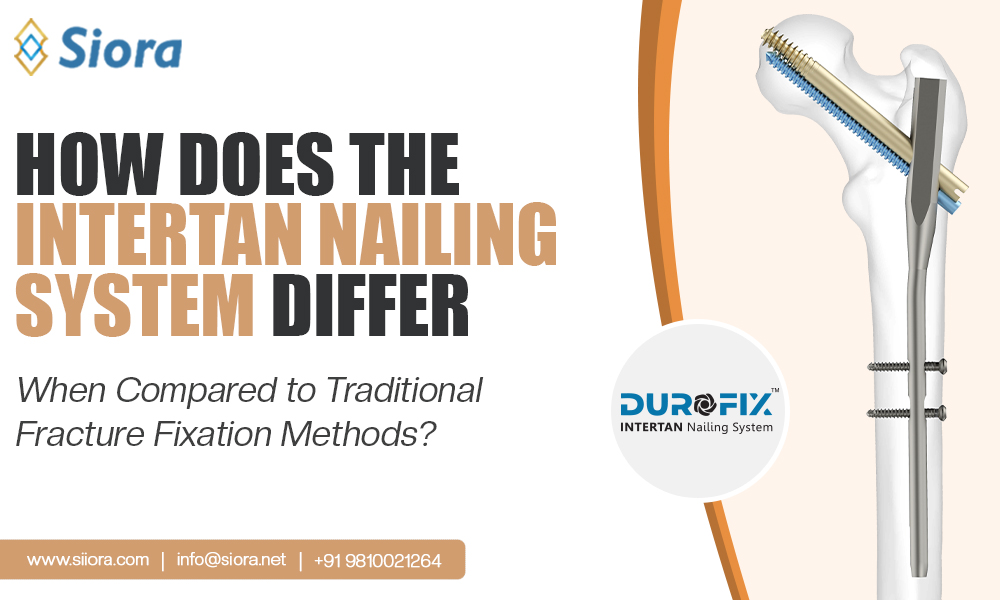
The Intertan nailing system was designed with better biomechanical control in mind. One major difference is its integrated dual screw mechanism. Instead of relying on a single lag screw, the system uses two interlocking screws that work together inside the femoral head.
This design improves rotational stability and reduces the chances of excessive collapse at the fracture site. In simpler words, the bone fragments remain more controlled during healing.
Another noticeable difference is the compression capability of the system. Controlled linear compression can be achieved during surgery, which helps bring fracture fragments closer together. Better compression often supports stronger and faster healing.
Improved Stability in Unstable Fractures
Traditional fixation systems may perform well in stable fracture patterns, but unstable fractures can be more difficult to manage. This is where the Intertan system often shows an advantage.
The nail is designed to provide strong fixation in osteoporotic bone and unstable intertrochanteric fractures. Because the implant controls rotation more effectively, there is usually less risk of screw cut-out or implant migration.
For surgeons, this added stability can make postoperative management more predictable.
Surgical and Recovery Benefits
Another reason many surgeons prefer the Intertan system is the minimally invasive approach associated with intramedullary fixation. Smaller incisions and limited soft tissue disruption may help reduce blood loss and postoperative pain.
Patients are often encouraged to begin mobilization earlier compared to some traditional fixation methods. Early movement is especially important in elderly patients, as prolonged bed rest may lead to additional complications.
Although surgical technique and patient condition always influence recovery, stable fixation generally supports better rehabilitation progress.
Considerations Before Choosing the Implant
Even though the Intertan system offers several benefits, implant selection should always depend on the fracture pattern, bone quality, and surgeon experience. Traditional fixation methods still remain useful in many situations and continue to provide reliable outcomes.
The Intertan system is not simply a replacement for every conventional orthopedic implant. Instead, it is another option that may offer better control and stability in selected cases.
Conclusion
The Intertan nailing system differs from traditional fracture fixation methods mainly through its dual screw design, improved rotational stability, and controlled compression capabilities. These features can help reduce complications and support more reliable healing, especially in unstable fractures.
As orthopedic technology continues to evolve, systems like Intertan are helping surgeons manage difficult fractures with greater confidence while also improving patient recovery experience.


Leave a comment