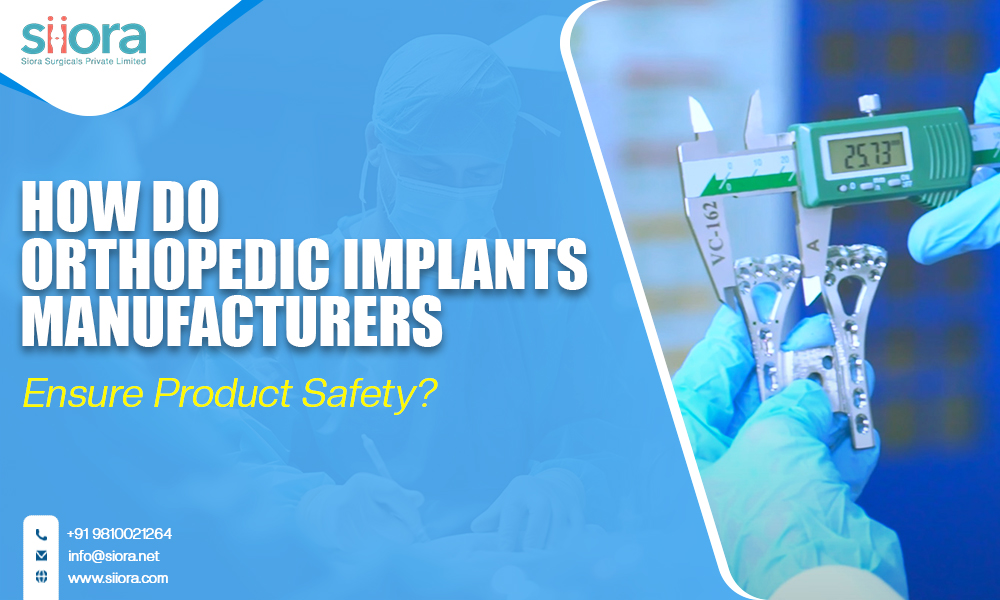
When a surgeon places an orthopedic implant inside a patient’s body, trust is involved at every level. The patient trusts the surgeon. The surgeon trusts the implant. And behind that implant stands the manufacturer. Product safety in orthopedic implants is not something that happens by chance. It is the result of careful planning, strict testing, and continuous monitoring.
Orthopedic implant manufacturers understand that their products are used in critical procedures—fracture fixation, joint replacement, spine stabilization, and trauma care. A small error in design or production can have serious consequences. That is why safety is built into every stage of development.
Starting with Design and Material Selection
Safety begins long before manufacturing. It starts at the design table. Engineers work closely with orthopedic surgeons to understand anatomy, biomechanics, and surgical techniques. The goal is to design implants that fit correctly, provide stability, and support natural healing.
Material choice is equally important. Most orthopedic implants are made from medical-grade stainless steel or titanium alloys. These materials are selected because they are strong, corrosion-resistant, and compatible with the human body. Before approval, materials go through biocompatibility testing to ensure they do not cause harmful reactions when implanted.
Following International Standards
Reputable manufacturers do not rely only on internal checks. They follow globally recognized quality standards. Many operate under ISO 13485 quality management systems, which focus specifically on medical device manufacturing. Risk management processes, often aligned with ISO 14971, help companies identify possible hazards and reduce them before products reach hospitals.
To meet the evolving demands of modern orthopedic care, trusted companies like Siora Surgicals Pvt. Ltd. also evaluate biocompatibility in accordance with ISO 10993, ultrasonic cleaning as per ISO 19227, and medical device labelling conforming to ISO 15223 requirements.
Regulatory approvals are another key layer of safety. Depending on the region, implants must meet requirements set by authorities such as the FDA, CE regulatory bodies, or other national health agencies. These approvals involve documentation review, technical evaluation, and performance testing.
Precision Manufacturing and Clean Environments
Even the best design can fail if manufacturing is not controlled properly. Orthopedic implants are produced using advanced CNC machines and precision engineering tools. Tolerances are kept extremely tight to ensure accurate dimensions.
Manufacturing areas are carefully monitored. Many steps, especially cleaning and packaging, are done in controlled environments to prevent contamination. After production, implants undergo surface finishing processes that improve smoothness and reduce the risk of corrosion or wear.
Each batch is tested for mechanical strength. Fatigue testing, torsion testing, and load-bearing analysis help confirm that the implant can handle real-life forces inside the body.
Cleaning, Sterilization, and Packaging
Once manufactured, implants must be thoroughly cleaned. Advanced cleaning systems remove microscopic particles, oils, or residues left from machining. Some companies validate ultrasonic cleaning processes to ensure consistency.
Sterilization is another critical step. Implants are sterilized using approved methods such as gamma radiation or ethylene oxide, depending on the product type. Packaging is designed to maintain sterility until the moment the surgeon opens it in the operating room.
Clear labeling is also part of safety. Labels include product details, size information, lot numbers, and usage instructions. This helps hospitals maintain traceability in case of any future concerns.
Post-Market Monitoring and Feedback
Product safety does not end once the implant is sold. Responsible manufacturers monitor product performance even after it reaches the market. They collect feedback from surgeons, track complaints, and investigate any reported issues.
If improvements are needed, companies update designs or processes accordingly. In rare cases where a defect is identified, recall procedures are already in place to protect patients.
A Continuous Commitment to Safety
Ensuring product safety in orthopedic implants is not a one-time task. It is an ongoing responsibility. From design and material selection to manufacturing, sterilization, and post-market follow-up, every step matters.
For surgeons and patients, this layered approach provides reassurance. Behind every implant lies a structured system designed to minimize risk and support healing. In the end, safety is not just a regulatory requirement—it is the foundation of responsible orthopedic manufacturing.To learn more about advanced orthopedic implants, regulatory standards, and other healthcare products, visit WHX FIME 2026.
 Ortho Surgical Implants