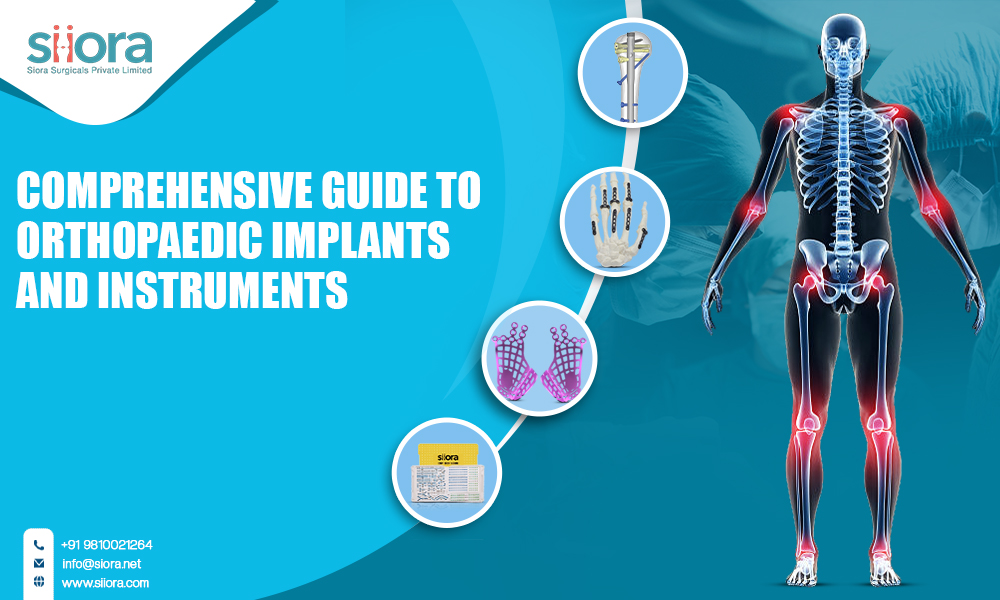
Ever watched a master carpenter at work? They have a specific tool for every single task, and a specific part for every joint. An orthopedic operating room is a lot like that, but way more advanced (and sterile). When a surgeon rebuilds a broken bone or replaces a worn-out joint, they’re using an incredible array of highly specialized parts and tools. It’s easy to get lost in the terminology. So let’s pull back the curtain and take a quick look at the two main categories: the orthopaedic implants that stay in your body, and the trauma instruments used to put them there.
The Parts That Stay: A Tour of Orthopedic Implants
Implants are the hardware that gets left behind to do a job. They are designed to be strong, biocompatible (so your body doesn’t reject them), and to help you heal. They generally fall into a few key groups.
Fracture Fixation Hardware
This is the stuff used to piece a broken bone back together. Think of it as an internal cast. It includes plates, which are like metal braces that are contoured to the bone and held on with screws. Then you have intramedullary nails (or rods), which are long metal rods that get inserted down the hollow center of a long bone like the femur or tibia. They act as an internal splint, holding everything straight while it heals.
Joint Replacement Implants
When a joint like your hip or knee is destroyed by arthritis, the solution is to replace it. A total hip replacement involves a metal stem that goes into your femur, a metal cup that goes into your hip socket, and a ball and liner that create the new, smooth gliding surface. A total knee replacement is similar, resurfacing the ends of the femur and tibia with metal components and placing a durable plastic spacer in between to act as cartilage.
Spine Implants
Spine surgery is its own universe, but the hardware often involves two main things. When a disc is removed, surgeons often insert a spinal cage, which is a small, hollow box (often filled with bone graft material) that acts as a spacer to restore the proper height between vertebrae. To hold everything still so the bones can fuse together, they use pedicle screws and rods to build an internal scaffold.
The Tools of the Trade: A Peek at the Instruments
For every implant, there’s a whole tray of specialized instruments needed to put it in just the right spot. These are the tools the surgeon uses, and they don’t stay in your body.
The “Power Tools”
An orthopedic O.R. sounds a bit like a workshop. Surgeons use specialized drills to create perfect holes for screws, and high-speed saws to make precise bone cuts, especially during joint replacements. They also use reamers, which are like drill bits used to clean out and shape the inside canal of a bone so that an intramedullary nail will fit snugly.
The Hands-On Tools
This is the stuff the surgeon holds. There are hundreds of types of clamps designed to grab onto bone fragments and hold them together while screws are inserted. There are screwdrivers (both manual and powered), mallets for gently tapping implants into place, and forceps for handling tissue.
The “Measure Twice, Cut Once” Tools
Precision is everything. Surgeons use depth gauges to measure the exact length of the screw needed for a particular hole—too short and it won’t hold, too long and it can irritate the surrounding tissue. For complex procedures, they use guides that sit on the bone and direct the drill or saw blade to ensure the angle and position are perfect every time.
It’s this incredible combination of innovative implants and the precision instruments designed to place them that allows surgeons to achieve the amazing results they do every single day. One can’t exist without the other.
To explore Siora’s cutting-edge orthopedic implants and instruments, visit booth HN7.A71 at the annual WHX Dubai 2026 from 9-12 February 2026, at the Dubai World Trade Centre.
 Ortho Surgical Implants